Tuesday, April 5, 2011

Surgery Week - Day 2

Though today was the shortest day of the week that we've had so far, this is the most tired I have felt and many are feeling a little under the weather, including the student team.  Karina started to feel a little sick yesterday, and it has gotten worse today, so we decided to go back to the hotel so everyone could get rest and hopefully come back 100% tomorrow.

It is 3:00pm and we are back at the hotel.  Century and Karina went straight to their rooms to sleep.  I on the other hand am sitting in the lobby trying to access this spotty internet.  My roommate, Julie, is volunteering as a night nurse, so for the duration of surgery week she will be at the hospital from 7:00pm to 7:00am.  She has a ‘do not disturb’ sign on our room door, so I opted not to bother her.  Just snuck in for my laptop and a book.

For the hours we were at the hospital, we did get a lot in.  We were able to say bye to most all of the patients who received surgery yesterday and were being released this morning, including my new friend Haron.  Operation Smile doctors did surgery on his eye, releasing his eye/eye lid so that it would be more functional.  The skin was very tight around the eye and it was much smaller than the other, due to the burn that happened to him when he was a toddler.

Many new people showed up for screening again today.  There were six surgeries scheduled for each surgery table, and then more were added on this afternoon.  With five surgery tables, that comes to more than 30 surgeries.  The doctors, surgeons and nurses had a long day yesterday and will likely have another today.

In addition to helping, observing, and presenting at the hospital, the Student Team visited an orphanage and primary school. Century, Karina, Polly (a special guest), and Afia (Kenyan non-medical volunteer) brought many donations along with us to both places.  We gave the orphanage and school pencils, pens, sharpeners, paper, stickers, soccer balls, calculators shaped in rulers, and more.

The orphanage was the first stop.  It was for an orphanage for children from infant to eighteen years old. The orphanage is well known in the community and they say hospitals, local community groups and other organizations know of their work and refer orphan children there.  At the orphanage they receive care, food, and education.  At any one time they can have more than 150 orphans and some will stay until they are eighteen years old.  They also work with the government to allow adoptions of the orphans, mostly the infants and younger ones.

Some babies are abandoned at the hospital shortly after they are born; the mother walks out for a few minutes and never comes back.  They use a fake name when they check in.  Some children's only guardian is a grandparent and if the grandparent passes away, the children are left orphaned. If parents abandon their children and then come to claim them back, the must get a court order to prove that they are the parents.  

When we arrived, school was getting out so there were no older children there.  Only babies and young children.  We visited the nursery first, where we had to take off our shoes before entering.  Then we saw where the toddlers sleep.  Afterwards, we were able to hang out for the children for a little bit.  Many were running around barefoot with runny noses.  It took a minute for them to realize what we were asking, but we were able to get a great group photo!


The Moi Primary School was the second stop. On the way there, we found out that the school actually did not know we were coming.  Afia told us that the schools welcome guest and it should be no problem.  Immediately upon arriving we met with the Headmaster.  She was delighted to see us, and happy to arrange a visit with her students.  We found out that the school had a large attendance - 2,000! She was also happy that we were leaving so many things and said since tomorrow will be the last day of school until break, she would make sure they each received a gift.

We visited a 1st grade class and the students were great.  Typically, each class has 50 or more students in it.  They were very attentative to Karina and Century, as they presented on Burn Care and Prevention and Dental Hygiene.  Before we left, each student received a new toothbrush and pencil.  As we walked out, so many students followed us and wanted to have their photo taken.  They followed us all the way out the front gate of the school.


It was great to see a school.  The schools are very different from schools in the United States, though there are still the basic similarities.  The buildings were older, with the paint peeling.  There were wooden tables and chairs as desks.  A chalk board but the teacher had no chalk.  The room decorations on the wall were old newspapers.  But they all knew English well and seemed to be happy to be in school and learning.  It was so great to feel so welcomed, though we showed up unannounced.  I don't imagine that would ever go over well at a school back home.  Just getting through visitor check in can be a hassle.


Monday, April 4, 2011

Surgery Week – Day 1

Though I have so much to say, I am going to try and make this short.  At this moment, I only have five hours of sleep until our next wake up call.  Then it’s off to the hospital for Day 2 of Surgery Week.

Today there were more than 30 surgeries scheduled and more than 50 new people showed up for screening, which they missed this past weekend, in hopes to still be eligible for surgery.  There were many affected with cleft lips and cleft palates; some were approved and placed on the surgery schedule as early as this afternoon.  

Each day, I am more moved by the people we meet.  I met a man named Haron.  He was born in 1984, a year after I was. When he was three, he was severely burned (hands, body, all over his face, his eyes, his head). Despite his serious disfigurement, he greeted me and others with a smile and you could see and feel his immense kindness.  As he shared some of his story, he pulled out an article in the newspaper that was written up about him three years before (the article was an appeal for other locals to donate what they could and join together to help him receive the surgery he needed). 


Haron said he stopped going to school early on, as his eyesight was very bad from the burns and it made it difficult for him to learn.  I imagine that his appearance also made it difficult, and that some students did not show the same kindness to him.  It was empowering to know that he continued on, is now married with three children.  He has been the stay-at-home dad and his wife supports the family with odd jobs.  He is hoping that he soon can get a full time job and be the one to support his family.  In the article, his wife said that she has the best husband.  She married him because she knew he was a good man and did not care about the way he looked on the outside. I am in awe of his courage, positive spirit, and determination to carry on.

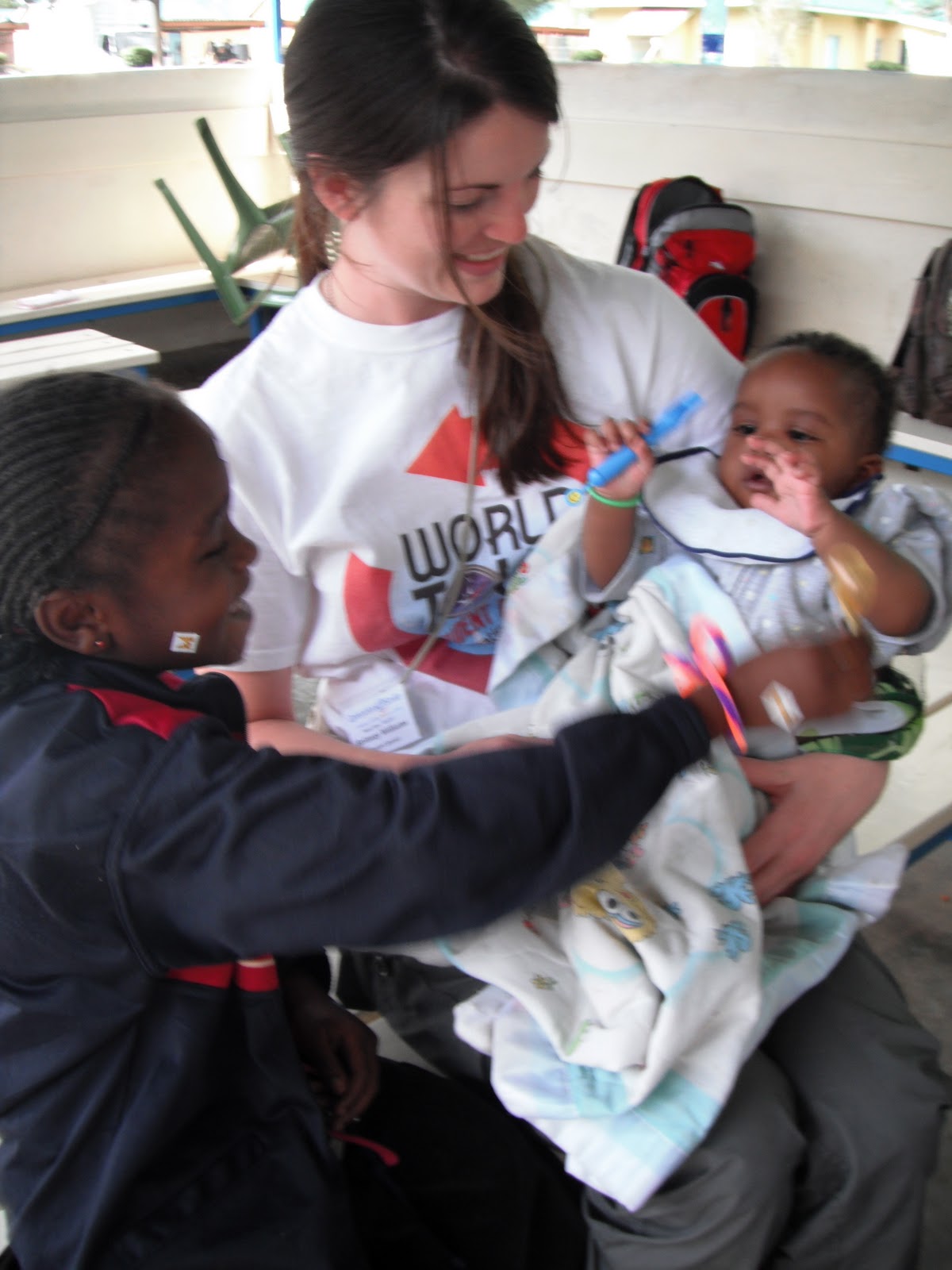
The other joyful part of my day was babysitting a beautiful tribal baby!  I still don’t even know her name since it is difficult to communicate with her mother.  Her mother is the woman from the Turkana Tribe and she was receiving surgery today.  She had a bad burn on her mouth and bottom lip.  Her bottom lip was so tight from the scarring that it basically wasn’t there or was immovable.  She also had some teeth that needed to be extracted in order to make it more functional after the surgery.  Though it was hard to communicate, a smile is a universal language.  After we exchange smiles, we were connected.  She let me get a photo of her and her baby and then trusted us to watch her baby while she went into surgery. 


This beautiful girl was in our care for many hours.  After her mother was out of surgery, she still needed to rest and did not want the baby back right away.  The little girl was less than a year and so cute and cuddly.  I think I held her for a few hours straight; I LOVED every minute of it!

I am closing with a fun photos that made me smile and I hope they do the same for youJ

Patient named Griffin

Baby getting ready to go into surgery - with the Clinical Coordinator, Donna

Patient and his daughter, Agnes - both from Turkana Tribe
She was so sweet!

A beautiful smile, even before surgery

Sunday - TEAM DAY!

Team Day!

Yesterday was our Team Day!  Every Operation Smile medical mission has a team day, or down day, where the team can do an activity together to bond, usually before surgery week starts.  We were lucky enough to go to Lake Nakuru National Park and take an excursion through it.  I am speechless about it…it was AMAZING!

We left the hotel at 6am.  The park was close by and we were able to see the sunrise upon arriving.  It took quite awhile to get into the park, as some had expected (the reason we had an extra early start). Everything takes time here and patience is something you must learn to have here. As soon as everything was sorted out, we were on our way!


The Park is known for its pink flamingos, however we didn’t see many at all and found out that they had recently migrated.  This was not to our dismay, as we saw hundreds of pelicans (with a pink tint), many baboons, monkeys, deer, and water buffalo.  We also saw hyenas, rhinos, zebras, giraffes and a hippo. 


The only other animal we were dying to see was a lion.  Apparently as it gets later in the day, they are much less likely to see.  I guess they are off hiding in the shade somewhere.  They come out early and a dusk (sounds similar to a shark, based around its feeding habits).  On this excursion we really lucked out…we saw a lion!  He was chilling under a tree. A few ventured out of the bus to take a photo but quickly returned.  The rest of us preferred the safety of the inside of the busy and took photos out of the window.

After seeing the lion, we made a stop to check out a waterfall.  There wasn’t exactly any water falling at the moment, just dripping, but it was still amazing to see.  There was a tree growing out of the side of the cliff and the water was murky brown.  One of the Kenyan volunteers, an extremely fun and friendly woman named ‘Ziphora,’ who goes by ‘Zippy,’ told us that the lion was likely watching us.  Ha…I’m not sure if she was kidding or not. 

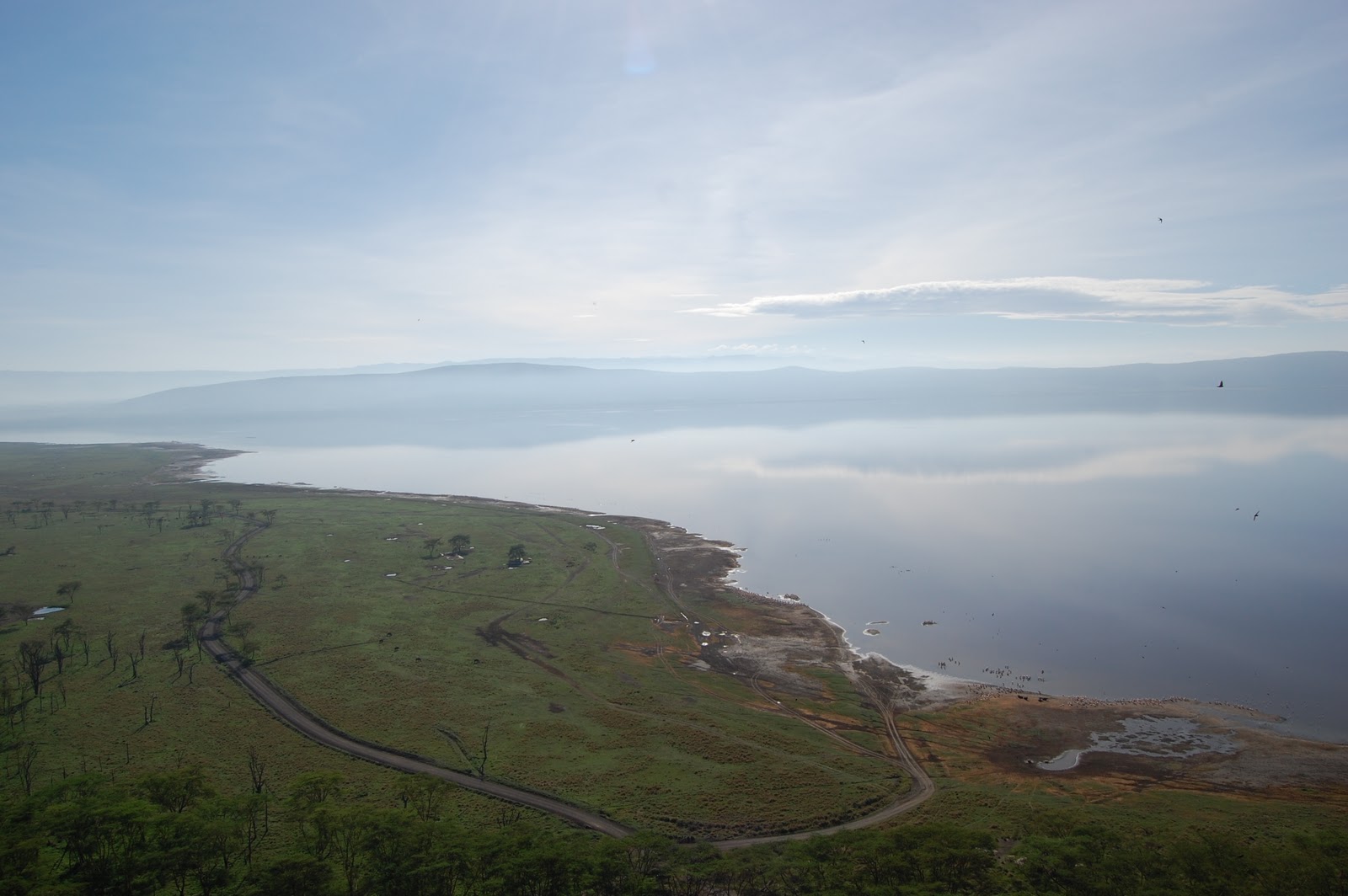
On our excursion we also stopped at a spot with the most incredible view.  Incredible doesn’t even do it justice. We could look down over the park and the lake.


Afterwards, we had a team lunch at a Lions Club (like a country club), where rumor has it that Kenyan government dignitaries were also there meeting.  There were a few helicopters parked out back in the grass – that was there transportation.  Today, the dignitaries and there meeting were on the cover of the local paper.

Our Team lunch was good.  To start off, the Kenyans from Nakuru all got in the middle of the conference room and sang a song for us.  It was about a train coming through and everyone had to get on.  No matter your color, culture, customs, if you were enemies, etc.  Everyone had to get on the bus.  On the bus, everything was okay despite the differences.  There are no problems on the bus, no worries, Akuna Matata! While singing, they lined up and danced around the room in a line representing the train.  They closed with this analogy, despite all of our different backgrounds, cultures, countries, we are all on the train together and the train won’t stop until surgery week is over. 

Then we each introduced ourselves, one by one, until the entire team of more than sixty had introduced themselves, said their profession, what they volunteer with at Operation Smile, and what their hobbies were.  It was a diverse group, but most enjoyed singing, dancing, traveling, outdoors, and making new friends. 

I never realized how extremely tiring a safari ride could be.  All you do is sit on a bus or in a car for hours, but you are always on the look for the next animal.  We all called it an early night so we could get Surgery Week started on time the next morning, all well rested.

Saturday, April 2, 2011

Day 2 of Screening

Today started off slow, beginning with an extra hour of sleep!  The buses did not depart to the hospital until 7:45am.  When we arrived we were expecting to have a large possible patient turnout but found only a few waiting.  We were unsure of how many would show up, but the slowly trickled in throughout the day, bringing our total number of patients screened to a little over 180.

The Student Team and I helped out different tasks throughout the day.  They started off printing photos for medical records.  Four photos printed per sheet and it was a slow process but they made it through, printing photos of every patient.  The photos are added to the patient’s chart, which is helpful in identifying them during surgery week.  I helped out with medical records.  We pre-filled out some of the basic info (date, site location, chart number) on all the chart forms.


Since it wasn’t as busy, many team members were able to get to work on the OR and setting it up sooner in the day.  Karina, Century, and I and some other non-medical volunteers helped put together “no-no’s” and IV boards made out of recycled cardboard.  The “no-no’s,” mostly only needed for younger patients, go around both of their arms near their elbow, so that they cannot bend their arms to mess with the area that received surgery. 

A woman from the Maasia Tribe came with her two year old son today.  He had cleft and was extremely cute, curious, and eager to play with a ball, a truck and bubbles. He was walking everywhere.  His mother seemed to also have a majestic nature to her, similar to the people from the Turkana Tribe.  She wore brightly printed fabric wraps and her ear lobes had holes stretched long with earrings adorned with beads.  She seemed somewhat uncomfortable in the surroundings, as she would stand off alone watching her son play and when she made eye contact with others she did not give any facial expression, acknowledgement or smile. It is so interesting to even see the different cultures, values, and ways of life within the country.

The Maasai Mother

and her baby waiting for Karina to blow bubbles:)


Today was an emotional day for us.  There was a young girl who showed up with her mother.  She was very beautiful. When we asked why she was there to see Operation Smile, the mother undid her daughter’s pony tail and pulled apart the braids.  The back of her daughter’s head had been burned and the skin was scarred and she had no hair there. She had hair on one side of her front hairline and some on the very bottom of the back of her head.  She wore her braids to the side and back to cover up the area.

Her mother wanted to know if Operation Smile could do some sort of skin graft to make it so that hair would grow back.  The surgeon came out to take a look and said that it could be done, but unfortunately it is not something that Operation Smile would be able to do.  It would take multiple surgeries and many months.  He did give her the name of a very good surgeon in Nairobi, but it is likely that she will not be able to afford the care that she wants for her daughter.  


After hearing the news from the doctor, she tried to stay strong but then broke down; we could sense her overwhelming feeling of defeat and see it, as she started to cry.  The Kenyan nurses tried to console her as she got up to walk away, telling her that she had a beautiful daughter; some tried to hug her as she walked away. The little girl got up to follow after her.  As they left, we were all so moved by the mother's despair that before you knew it, we were all watery eyed with tears following.  Together we cried for this little girl and her mother.  Though Operation Smile volunteers bring so much hope and happiness, there are many people that have to be turned away and it is truly heartbreaking.

After we all cried and then laughed at each other's emotional breakdown, with tears still coming, we were soon greated by new children and people to be screened.  We met some special girls, Rachel, Marcy, and Loksana.  They were adorable and smart.  They spoke in English, sang us a song, played, and listened attentively to a Dental Hygiene presentation. 


I also held my first Kenyan baby, a 7 month old girl, named Happiness.  Yes, her name was Happiness and she was an extremely content baby and so beautiful.  Marcy was her cousin, and though she was only seven, she was carrying Happiness around and then brought her to me and plopped her down in my lap.  


All in all it was a great day.  Tomorrow is our Team Day and we will be off to Lake Nakuru National Park at 6am sharp!!  The word on the street is, the earlier you get there the more animals you are likely to seeJ

Friday, April 1, 2011

Day 1 of Screening!

Today the whole team got up bright and early!  Wake up calls, or should I say wake up knocks, were at 5:30am, breakfast at 6:00am, and we were off to the hospital at 7:00am.  There was a little hitch in transportation, but with many taxis and a few vans, we made it to our destination for the day – the Rift Valley Provincial General Hospital.

I believe every mission gets off to a hurried, somewhat chaotic start, but in no time things seem to fall in place and everyone settles into a steady flow for the screening process. That’s just how today started.  Everyone went right to work and by the end of the day 136 patients had been screened!

The Student Team got to work too.  We spent most of the day in the initial waiting tent, were patients were directed to come first.  Here they received a number on an Operation Smile sticker; numbers were given in order of their arrival.  Then they patiently waited, some for many hours, until it was their turn to proceed through the screening process.  It seemed none of the patients or families had brought anything with them – no toys, no food or drinks, no things to pass the time.  They just waited patiently, waiting for their chance to be seen by the doctors, and hoping that this time they could be helped.

Waiting area tent for those waiting to be screened.

In the tent, not only were their bubbles, inflatable balls, stickers and more, to entertain the patients and also put them at ease during their wait, but Karina and Century gave three really great health care presentations to the large groups waiting.  One of the first girls we met was named Roselyn and she was twelve years old.  She spoke Swahili but also English, as English is the main language taught in her school.  Roselyn was extremely outgoing, intelligent and sweet and we quickly recruited her to translate for the presentations.

Roselyn and I:)

The first presentation was on Burn Care and Prevention.  Karina and Century would present the information, little by little, and Roselyn would translate.  The most touching part of this first presentation, was not only watching how well they did, but also knowing that Roselyn herself was here to see Operation Smile because of a burn she received when she was a little girl, almost too young to remember.  She could share her story and help educate others on how to prevent and care for burns, through helping the Student Team.  Roselyn continued to translate for the rest of the day, assisting with the Dental Hygiene and Nutrition presentations as well.

Burn Care and Prevention Presentation

Dental Hygiene Presentation

There was also an extremely helpful Kenyan nurse, Jane, who repeated all of the translations to make sure the entire group understood the information, as she too knew how important it was.  Jane was so kind to us throughout the day.  She told me that she works at the Rift hospital and has been volunteering with Operation Smile for many, many years, since almost the very beginning.  She asked me about my education, studies and career and I found out that she had a daughter who was also 28, currently a dietician planning to get a Masters in Public Health.

Towards the end of the day, we had another group of patients arrive.  There was a very beautiful young girl who looked fourteen or fifteen but said she was twenty. Her baby had a cleft lip and palate and you could easily tell that the baby had a difficult time feeding because of its size.  Another woman, whose neck was adorned with many beaded necklaces stacked high was there with her baby.  It took a few moments to realize that her baby was happy and healthy and that the mother was here for herself.  She had skin growths on a few places on her body and it seemed that around her mouth had most likely been burned.  The left side of her mouth and her bottom lip were pulled tight and scarred.  There were a few other patients with them too.

The most interesting and intriguing part of these people is that they are from Turkana, and part of the Turkana Tribe. The Turkana tribe is a nomadic pastoralist people that inhabit the Turkana district in Kenya's Rift Valley Province. The patients from Turkana had to walk for more than four hours and then catch a bus to get to the site.  They shoes sandals were worn and tattered and they did not bring many belongings. It is hard to believe that nomadic groups of people still exist and live like they do.  There is something so beautiful about their simplistic way of life.

Four or five years ago, on another Operation Smile medical mission in Nakuru, two sisters from the Turkana Tribe arrived, both having a cleft lip.  Some of the volunteers on this trip were also on that one.  They said the girls were gorgeous, both almost 6 feet tall and with beautiful skin and teeth. 

Fortunately, they were both able to receive surgeries on their clefts before heading back to their tribe.  Ironically, today, one of the volunteers received a call from an old friend in Kenya, informing them that one of the sisters is getting ready to be married.  Something that may not of happened had she still had a cleft. 

We wrapped up this afternoon, with a packed full ride back to the hotel, then did a little shopping in the market across the street, and had dinner in the hotel restaurant.  Everyone wanted our business, so we had to be hard bargainers.  I’m not sure we were as hard of bargainers as we’d hoped to be, but the students and I are very satisfied with our purchases:)

Thursday, March 31, 2011

Hakuna Matata!

A word often used in Kenya is “Hakuna Matata,” meaning ‘there is no problem’ or ‘no worries.’ As our journey begins, I have a feeling this is a phrase we will refer to over and over…

After 22 hours of traveling, including 18 hours in the air, the student team and I and many other volunteers arrived in Kenya!  Travels went abnormally well, with no delays, no missed flights, and no lost luggage. Hakuna MatataJ

It felt so good to finally arrive, bringing full realization to the journey we were about to embark on.

Many volunteers had arrived by the time we did, and we all stayed the night in a hotel in Nairobi, welcoming the chance to rest and get some sleep in a bed.  Not only was the travel somewhat exhausting, but had you seen our luggage, you would know that carting it around brought twice the exhaustion.  Most all of us packed light when it came to our own essential needs, but packed heavy with donations, donations, more donations and special gifts, all to leave behind with the patients, families, and new friends we meet along the way. Multiple suitcases were packed completely full of donations, some 50 pounds or more. 

There was no way we would all fit in two vans with our luggage too. So our coordinator decided to call for a third van, so we could get from the airport to the hotel in one trip, two vans for people and one van completely full with luggage.  When I say full, I mean FULL - from the seats to the roof. Hakuna MatataJ

We have not met the entire team yet, but already there is a sense of family and teamwork amongst all.  There is diversity but also unity: different backgrounds, different cultures, different countries, but all together as a team for one cause: to change lives, one smile at a time! Medical and non-medical volunteers have come from all over (Australia, Egypt, Kenya, South Africa, Sweden, and the United States – CA, FL, IL, MS, NM, NY, OH, UT, and VA).  There are approximately 27 volunteers from Kenya alone, with 62 volunteers total, but together 1 team!  Hakuna MatataJ

After a cold shower, one so cold that I forfeited washing my hair, and a good night’s sleep, we had a wonderful breakfast before boarding the buses to head to Nakuru, the site where new smiles would soon be created.  The next two and a half to three hours would be spent on the highway. 

Luckily, the road had been paved, which wasn’t the case not long ago.  However, our bus trip took longer than expected due to a flat tire.  Once the driver realized the tire blew out, we slowly pulled off the road.  There were not people, buildings or towns nearby, so we all got off the bus, sat in the grassy field next to the road and took time to sit and relax, taking in the scenery, the green brush, and the big blue sky.  The tire was removed and the spare replaced in no time. Hakuna MatataJ

Throughout the ride, I sat back taking it all in, in awe of this new experience, new country, new culture, and acknowledging and appreciating the similarities and differences.  We passed homes, stores, markets, and many people working or carrying out their daily ways of life: Some out in fields farming the land by hand, some working on landscaping, others selling fruits, vegetables and peanuts on the side of the road...  There were stands where animal skins were hanging out to dry and for sale. There were many vibrant colors, bringing buildings, homes, and schools to life. There was a scenic stop along the way, where we were able to get photos of the start of the Rift Valley and three mountains nearby. Kenya is a beautiful country and so are its people.

Now that we’ve made it to Nakuru, our destination for the next ten days, we’ve had the afternoon to settle in, grab lunch, and prepare ourselves for the busy days ahead that will consume our every ounce of energy, and we will joyfully give of it.  I am confident that this amazing team of volunteers from all over will make it through this medical mission with ease!

All we have to do is remember these two words – Hakuna MatataJ


Sunday, March 27, 2011

Nur's New Smile

Smiles can fill your heart.  And right now my heart is full.

In his short stay in Virginia, my newest friend, Nur, made a profound impact on many lives, including myself.

Nur's life began in utter sadness.  He was born in a village in Assam, India with a very severe cleft.  A cleft that went from his lip to his eyes, causing him to only have half a nose and eyes that were pulled down.  He experienced abandonment and shame as soon as he was born, with his father deserting the family because of his son's facial deformity.  His father returned to the family a year later, but life was not easy for Nur.  School became unbearable so he had stopped attending early on. At such a young age, he experienced bullying, isolation, and shame, all because of the way he looked.

His uncle Nasi said that they visited many doctors in India, but all said there was nothing they could do for Nur's deformity.  They would not attempt to repair his cleft because they said it was not possible. Despite this, Nur's uncle and his family did not give up hope that Nur would one day be helped.

HOPE is a powerful thing.

In February 2010, Nasi heard about Operation Smile and that they were coming to Guwahati, India to help those affected with clefts.  He informed Nur's parents, and they decided to bring Nur to Guwahati that month to see if he could finally be helped.  They had to travel 190 kilometers (nearly 120 miles); this may not seem like a long distance but with the road conditions in India, it took more than five hours to travel to the medical mission site.  While there at the site, Nur was evaluated by many volunteer medical professionals and by Dr. Bill Magee, co-founder of Operation Smile. Dr. Magee said the magic words that Nur and his family had been hoping for, "Operation Smile could help Nur" but they would have to bring him to the United States.

Fast forward to September 2010, where I was fortunate to meet this little boy, Nur, when he arrived in Virginia Beach, VA. Initially, he was quiet, shy, and reserved with all he met, but once he realized that we were all so happy to meet him and were all there to support and help him, he quickly opened up.  Within was a bright, intelligent, sweet, courageous, energetic young boy.  He may be one of the smartest eight year old children I have ever met.  In less than a month he had learned the English alphabet, was counting to 10 - 20 - 30..., and was writing his name and other words.  Each and every moment, Nur was taking it all in, and repeatedly amazing us by his ability to learn so quickly, mostly from his own observation.

Over the next six months, Nur transformed from a boy whose deep sadness you could see in his eyes, to a boy whose energy, spirit and smile brightened the room.  It is amazing to notice a smile on the inside, just by looking at someone's eyes.  Not only was I lucky to see Nur's new smile on the outside, but I saw the smile that was on the inside; I saw his new smile in his eyes.

During his stay, Nur, Nasi and I made many visits to local schools (a few high schools and more than 15 elementary schools).  Each visit, Nur opened up more and more.  By the last presentation, he was helping me by clicking through each power point slide and playing a few tricks too (putting his hand in front of the projector light to make shadows on the board or disappearing into the crowd of students like he was a classmate listening in on the presentation too, instead of standing up front with me).

His story, his charm, and his strong desire to be normal just like the other students allowed him to become an immediate super star at every visit.  He received so many high fives, hand shakes, and even hugs. Each school welcomed him with open arms, a much different environment than his school back at home.  To witness his transformation and the transformation of the other students, who set aside physical differences to accept this boy and treat him like a classmate and a friend, was truly touching.


Though he says he wishes to be a doctor one day, I think he may also have a chance at professional basketball.  At schools, the students would crowd around as he sank hoop after hoop! Out in the soccer field, he held his own with 4th and 5th graders, all bigger in size and a few years older.  It didn't phase Nur at all.  He tried each and every game, and showed us that he was also quite the jump roper and monkey bar climber:)  Each school closed the visit with special gifts for Nur, as if the visit alone wasn't special enough.  By the time Nur had to begin packing for his return home, he had tons of school t-shirts,  hats, pens, notepads, jump ropes, balls, games, and more.  All special momentos for him to cherish always and remember the hundreds of students he met.


Nur made a profound impact on my life.  I witnessed an amazing example of the human spirit, what it can endure, and how through the compassion and kindness of so many, a life can be changed forever.  It was a bittersweet farewell to send Nur and Nasi back to their home and family in India, as they both had become family to so many here.  They touched so many lives in their short stay.


My life has been touched by this little boy and his uncle, and all who have donated their time, talents, energy and kindness to help restore a smile, inside and out.